I am a scientist, and science has at times challenged my passion for photography.
Since the late 1980s, I have worked scientifically with whales. One of the fundamental methods is what we call photo-identification, or simply photo-ID. It involves photographing distinctive parts of a whale’s body and using those images to recognize individual animals.
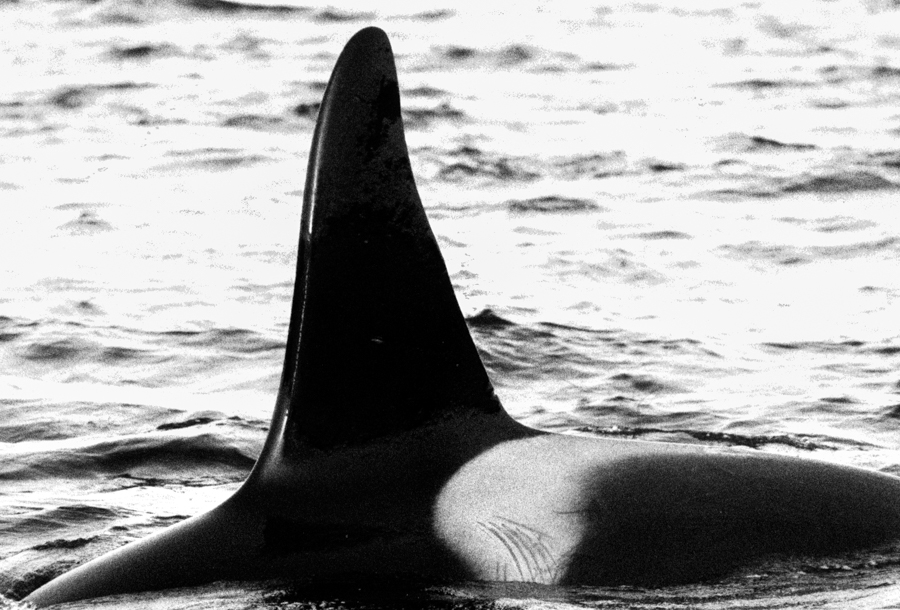
For killer whales, the profile of the dorsal fin and the markings around it can be distinctive enough for us to recognize the same whale year after year. In that sense, a photograph becomes a natural mark.
Birds may be fitted with rings, and many animals are tagged in one way or another. With whales, however, there is often no need for an artificial mark. Their natural features are already there, and a photograph can function almost like a fingerprint. Today, natural markings are used to identify and monitor individuals in species across virtually every major group of vertebrates, from whales and sharks to big cats, reptiles, amphibians and fishes — and even in some invertebrates.
Over the years, this way of working has meant taking thousands upon thousands of photographs of whales, in my case only killer whales. But most of them were never taken because they were beautiful, even if they really are. They were taken because they were useful.
The ideal photo-ID image is technically clear, correctly exposed and taken at the right angle. It should show the features needed to identify the animal. Composition, mood, light and atmosphere are secondary. In scientific work, a photograph is first of all data.
That distinction has affected the way I tend to photograph whales. When an animal surfaces close to the boat, I am always looking for the dorsal fin, the saddle patch, the angle, the side of the animal, while my mind runs through an internal archive, trying to work out whether I already have the identification photograph I need. It has become almost instinctive, much like the way I still find myself scanning the horizon whenever I am on a boat, always looking for whales. It is difficult simply to watch, and it is equally difficult simply to photograph for the sake of the image itself. Over time, it has also had the effect that I often do not reach for the camera unless I feel I have to.
Perhaps this is why whale photography has sometimes felt strangely different from the rest of my photography. I may be surrounded by dramatic light, mountains, snow and whales, yet still find myself taking another perfectly ordinary identification photograph, simply because I feel I should. And I really should - spoken from a scientific perspective.
There is, of course, nothing wrong with that. Those images have scientific value, and together they can tell us remarkable things about individual whales over many years. But after decades of working this way, I feel a strong need to reclaim photography from science — to recover the curiosity, freedom and pleasure of making an image simply because it moves me.
The challenge is to remember that the whale is not only an individual in a catalogue. It is also an incredible creature, a part of a landscape, a moment, a behaviour and an experience. Sometimes the most important photograph is not the one that gives the clearest identification, but the one that says something about what it felt like to be there.