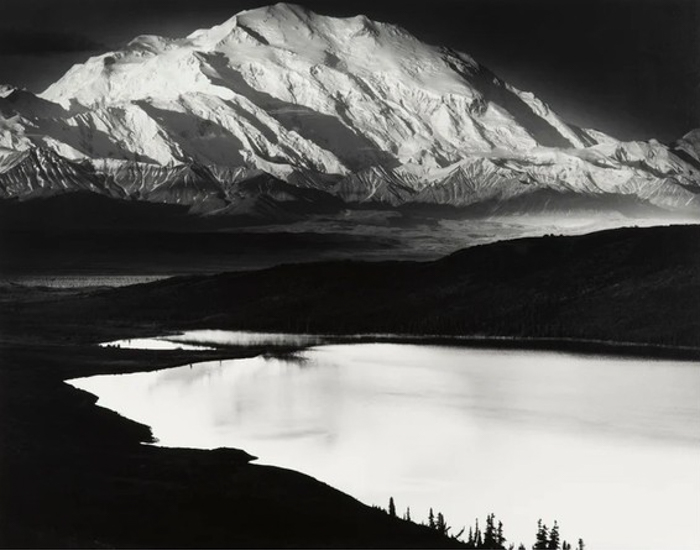
The master of expressive landscape photographs in black and white.
In the late 1980s and early 1990s, I entered what became a serious darkroom period, at the same time as I was developing my scientific work with photo-identification. I quickly realised that if I wanted to become a better printer, I needed guidance. Developing black-and-white negatives was relatively straightforward and, once the basic technique was under control, the results were usually as good as the exposure allowed. Printing, however, was a very different matter.
My photo-identification images of killer whales were shot on black-and-white film. We often had to push the film to achieve a higher effective sensitivity, because fast shutter speeds were essential for keeping fast-moving whales in focus. That technical necessity made the darkroom an important part of the scientific process.
Then I came across the photographs of Ansel Adams, and they had a profound impact on me. I ordered his three books — The Camera, The Negative and The Print — through my local bookstore. When they arrived, I spent a long period almost disappearing from friends and daylight, working in the darkroom facilities at the university campus where I was employed as a killer whale researcher.
Adams’ photographs resonated strongly with me. He also worked in black and white, and he showed me that printing could become something far more deliberate and expressive than simply reproducing what had been captured on the negative. He was not afraid of dramatic interpretation. Even when his images looked natural, they were certainly not neutral. Skies could be much darker than we might perceive them, clouds more dramatic, and foregrounds carefully suppressed or brought forward. The final print was an interpretation of the scene rather than a literal transcription of it.
He was associated with a group of photographers known as Group f/64, a name that referred to the very small apertures often used on large-format cameras to achieve exceptional depth of field and fine detail. Their emphasis on sharpness, clarity and carefully controlled tonal range appealed strongly to me.
Adams’ work inspired me to buy an old Mamiya RB67 medium-format camera, hoping to explore that kind of deliberate landscape photography myself. In the end, however, I never used it as much as I had imagined. Scientific work and the demands of photographic data collection increasingly took over, and most of my photography remained tied to research rather than to the slower, more contemplative kind of image-making that Adams had inspired.
His style — the large, carefully composed landscapes, the tonal richness, the clarity and the sense of grandeur — has stayed with me ever since. He remains one of my strongest photographic inspirations.